



Q5 Case Cracking Formulas: Learning Sum-thing
There is more math!
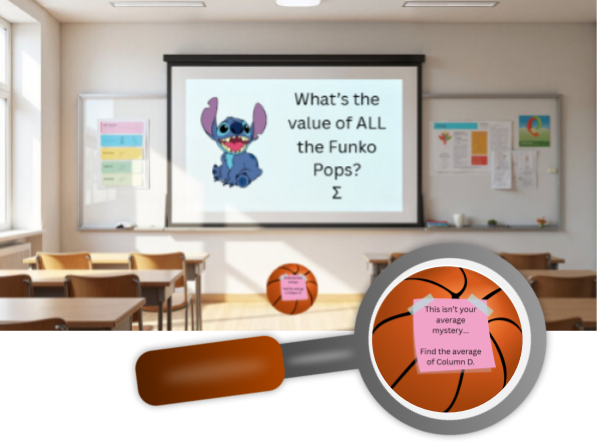
Returning your attention to the classroom objects, you still have two other items that were not typically in the room: Stitch on the overhead and the basketball with a note.
You now understand that you have to work with the Funko Pops spreadsheet again, and once you magnify the note, you notice it must be another spreadsheet related to sports!
Sum & Average are the Key!
After playing the video, you recall the spreadsheets you found earlier. Ah-ha, there was a minifig spreadsheet!
Step 1. Go to your Thing 13 Data Detectives folder, where you saved the Funko Pop Spreadsheet. Use the copy that you already have saved.
- Answer the question from the overhead in the classroom.
- What is the value of "All the Funko Pops?"
- You may want to play the video on the Clue Calculations page again, starting at timestamp 2:27 min.
Step 2. Now, you need to deal with the basketball clue, and it must do with one last spreadsheet. From the 13. DD Spreadsheet folder, select the Sports Cards spreadsheet (or use this direct link).
- If you are a Google User, make a copy and save it in your Thing 13 Data Detectives folder.
- If you are a Microsoft User, download a copy and then upload it into your Thing 13 Data Detectives folder.
Step 3. Find the average of Points per Game (Column D).
- Again, the video will provide the steps for finding the average in a spreadsheet.
Step 4. Go to your 13. Data Detective Notebook that you have saved in your Thing 13 Data Detectives Folder. On slide 11, Q5 Case Cracking Formulas: Learning Sum-thing:
- Record your answers to the posted questions and prompts.


Competencies & Standards
MITECS Michigan Integrated Technology Competencies for Students, and
1. Empowered Learner
d. Understand fundamental concepts of how technology works, demonstrate the ability to choose and use current technologies effectively, and are adept at thoughtfully exploring emerging technologies.
5. Computational Thinker
a. Formulate problem definitions suited for technology-assisted methods such as data analysis, abstract models, and algorithmic thinking in exploring and finding solutions.
b. Collect data or identify relevant data sets, use digital tools to analyze them, and represent data in various ways to facilitate problem-solving and decision-making.
6. Creative Communicator
c. Use digital tools to visually communicate complex ideas to others.
Websites and Documents
21T4S Documents & Quizzes